Melanoma vs. Other Skin Cancers: Key Differences
- posted: Oct. 14, 2024
Melanoma is a unique type of skin cancer. At Dermatology & Dermatologic Surgery Group of Northern Virginia in Vienna, VA, Dr. Linda Nims, Dr. Rebecca Barry, and Dr. Kelley Redbord diagnose and treat both types. It's important for you as a patient to understand how melanoma differs.
Melanoma Is More Likely to Spread Internally
Non-melanoma skin cancers are usually removable and rarely spread beyond the skin, as the National Institutes of Health noted. Non-melanoma skin cancers are typically found early because they tend to grow slowly, and you usually see an odd skin blemish and receive treatment before it has time to spread far.
However, melanoma skin cancers are more aggressive and grow faster. They can enter your lymphatic system or bloodstream and spread as they grow deeply. In most cases, the cancer will spread to one of the following areas:
- Lymph nodes
- Bones
- Stomach
- Brain
- Liver
- Lungs
For this reason, the survival rate for melanoma and other skin cancers differs. Those with basal cell carcinoma have a 100 percent five-year survival rate, and those with squamous cell carcinoma have a 99 percent five-year survival rate.
While the five-year survival rate of melanoma, when it's found early, is 99 percent, that figure drops to 32 percent whenever it has the opportunity to spread distantly.
Appearance
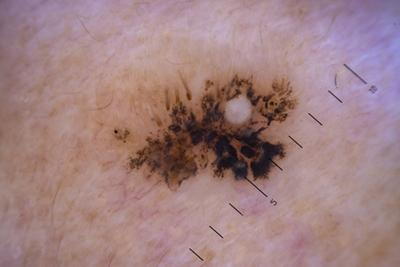
Melanoma may resemble a mole when it first appears, which does not trigger any concern, considering the average person has 10 to 40 moles, according to American Academy of Dermatology Association (AADA) statistics. However, this is the type of cancer you must monitor changes in moles by checking for asymmetry, an irregular border, a difference in color, etc.
Other forms of skin cancer tend to cause noticeable changes, like an open sore that oozes or crests or a wart-like growth.
Causes
UV radiation from the sun is the main cause of all types of skin cancer. With that said, though, melanoma is the skin cancer you can be more at risk for based on your genetics. The more common genetic mutation associated with melanoma is the CDKN2A (p16) gene, though there are others.
Interestingly, melanoma is most likely to occur in younger people because of its possible genetic link and because melanocytes are sometimes more active due to hormonal changes.
Suppose you have a peculiar mole or any other odd skin issue. In that case, we recommend scheduling a visit with Dr. Nims, Dr. Barry, or Dr. Redbord at Dermatology & Dermatologic Surgery Group of Northern Virginia in Vienna, VA. We also do routine testing.
Call 703-938-5700 for an appointment today.
- posted: Oct. 14, 2024
Melanoma is a unique type of skin cancer. At Dermatology & Dermatologic Surgery Group of Northern Virginia in Vienna, VA, Dr. Linda Nims, Dr. Rebecca Barry, and Dr. Kelley Redbord diagnose and treat both types. It's important for you as a patient to understand how melanoma differs.
Melanoma Is More Likely to Spread Internally
Non-melanoma skin cancers are usually removable and rarely spread beyond the skin, as the National Institutes of Health noted. Non-melanoma skin cancers are typically found early because they tend to grow slowly, and you usually see an odd skin blemish and receive treatment before it has time to spread far.
However, melanoma skin cancers are more aggressive and grow faster. They can enter your lymphatic system or bloodstream and spread as they grow deeply. In most cases, the cancer will spread to one of the following areas:
- Lymph nodes
- Bones
- Stomach
- Brain
- Liver
- Lungs
For this reason, the survival rate for melanoma and other skin cancers differs. Those with basal cell carcinoma have a 100 percent five-year survival rate, and those with squamous cell carcinoma have a 99 percent five-year survival rate.
While the five-year survival rate of melanoma, when it's found early, is 99 percent, that figure drops to 32 percent whenever it has the opportunity to spread distantly.
Appearance
Melanoma may resemble a mole when it first appears, which does not trigger any concern, considering the average person has 10 to 40 moles, according to American Academy of Dermatology Association (AADA) statistics. However, this is the type of cancer you must monitor changes in moles by checking for asymmetry, an irregular border, a difference in color, etc.
Other forms of skin cancer tend to cause noticeable changes, like an open sore that oozes or crests or a wart-like growth.
Causes
UV radiation from the sun is the main cause of all types of skin cancer. With that said, though, melanoma is the skin cancer you can be more at risk for based on your genetics. The more common genetic mutation associated with melanoma is the CDKN2A (p16) gene, though there are others.
Interestingly, melanoma is most likely to occur in younger people because of its possible genetic link and because melanocytes are sometimes more active due to hormonal changes.
Suppose you have a peculiar mole or any other odd skin issue. In that case, we recommend scheduling a visit with Dr. Nims, Dr. Barry, or Dr. Redbord at Dermatology & Dermatologic Surgery Group of Northern Virginia in Vienna, VA. We also do routine testing.
Call 703-938-5700 for an appointment today.
Dermatology & Dermatologic Surgery Group of Northern Virginia, PLLC
243 Church Street NW, Suite 200-C,
Vienna, VA 22180
Monday - Friday
9:00 am - 12:30 pm
1:30 pm - 4:30 pm
Saturday, Sunday
Closed