5 Skin Cancer Warning Signs You Should Never Ignore
- posted: Jan. 07, 2026
Skin cancer is the most common form of cancer in the United States, but it is also one of the most treatable when caught early. In Northern Virginia, where we enjoy active outdoor lifestyles, from hiking in Great Falls to weekend trips to the coast, sun exposure is a reality of life. At the Dermatology & Dermatologic Surgery Group of Northern Virginia, our board-certified dermatologists, Dr. Linda Park Nims, MD, Dr. Rebecca Rudd Barry, MD, and Dr. Kelley Pagliai Redbord, MD, emphasize that your best defense is a proactive eye.
While an annual professional skin exam is essential, "between-visit" monitoring is where many life-saving catches happen. Here are five warning signs that mean it’s time to schedule a visit to our Vienna, VA, office.
1. The "ABCDEs" of a Changing Mole
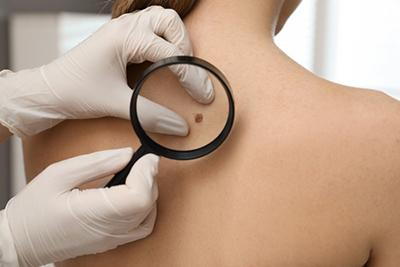
When evaluating your moles, we look for specific markers of melanoma, the most dangerous form of skin cancer. If you notice a mole that fits any of these descriptions, it requires immediate professional evaluation:
- Asymmetry: One half of the mole does not match the other.
- Border: The edges are ragged, blurred, or irregular.
- Color: The mole has multiple shades of tan, brown, black, or even splashes of red and blue.
- Diameter: The spot is larger than a pencil eraser (though melanomas can be smaller).
- Evolving: This is the most important sign. Any mole that changes in size, shape, or color should be checked.
2. The "Ugly Duckling"
Sometimes, a mole doesn’t necessarily fit the ABCDE criteria perfectly, but it simply looks different from every other spot on your body. Most people have a "signature" type of mole. If you have 20 brown, circular moles and one that is pinkish and oval, that "ugly duckling" is an outlier that warrants a closer look under a dermatoscope.
3. A Sore That Doesn't Heal
Basal Cell Carcinoma (BCC), the most common type of skin cancer, often hides in plain sight. It frequently appears as a small, pearly bump or a scaly patch that may bleed, crust over, and then seem to "heal", only to return a few weeks later. If you have a spot that has been "acting up" for more than three weeks, it isn't just a stubborn pimple or a scratch; it could be a BCC that needs to be removed.
4. New, Rapidly Growing Growths
Squamous Cell Carcinoma (SCC) often presents as a firm, red nodule or a flat lesion with a scaly, crusted surface. These often appear on sun-exposed areas like the face, ears, and hands. Unlike a benign wart or skin tag, SCCs can grow relatively quickly. Any new growth that feels rough to the touch or develops a "horn-like" appearance should be evaluated by a specialist.
5. A Dark Streak Under the Nail
Skin cancer doesn't always appear on the skin itself. Subungual melanoma can appear as a dark streak running vertically under a fingernail or toenail. While this can sometimes be a simple bruise (subungual hematoma), a bruise will grow out with the nail. If the streak remains stationary or begins to widen, it is a critical warning sign that requires a biopsy.
Why Early Detection Matters in Vienna, VA
When skin cancer is identified in its earliest stages, the treatment is often a simple, in-office procedure with an extremely high cure rate. At our practice, we utilize advanced diagnostic techniques and specialized surgical interventions, including Mohs surgery, for certain types of cancer, to ensure the best possible medical and aesthetic outcomes.
Ignoring a suspicious spot won't make it go away, but it may make the eventual treatment more complex. We invite you to be a partner in your own skin health.
Have you noticed a new or changing spot on your skin? Schedule a comprehensive skin cancer screening with Dr. Nims, Dr. Barry, or Dr. Redbord by calling our Vienna, VA, office at (703) 938-5700.
- posted: Jan. 07, 2026
Skin cancer is the most common form of cancer in the United States, but it is also one of the most treatable when caught early. In Northern Virginia, where we enjoy active outdoor lifestyles, from hiking in Great Falls to weekend trips to the coast, sun exposure is a reality of life. At the Dermatology & Dermatologic Surgery Group of Northern Virginia, our board-certified dermatologists, Dr. Linda Park Nims, MD, Dr. Rebecca Rudd Barry, MD, and Dr. Kelley Pagliai Redbord, MD, emphasize that your best defense is a proactive eye.
While an annual professional skin exam is essential, "between-visit" monitoring is where many life-saving catches happen. Here are five warning signs that mean it’s time to schedule a visit to our Vienna, VA, office.
1. The "ABCDEs" of a Changing Mole
When evaluating your moles, we look for specific markers of melanoma, the most dangerous form of skin cancer. If you notice a mole that fits any of these descriptions, it requires immediate professional evaluation:
- Asymmetry: One half of the mole does not match the other.
- Border: The edges are ragged, blurred, or irregular.
- Color: The mole has multiple shades of tan, brown, black, or even splashes of red and blue.
- Diameter: The spot is larger than a pencil eraser (though melanomas can be smaller).
- Evolving: This is the most important sign. Any mole that changes in size, shape, or color should be checked.
2. The "Ugly Duckling"
Sometimes, a mole doesn’t necessarily fit the ABCDE criteria perfectly, but it simply looks different from every other spot on your body. Most people have a "signature" type of mole. If you have 20 brown, circular moles and one that is pinkish and oval, that "ugly duckling" is an outlier that warrants a closer look under a dermatoscope.
3. A Sore That Doesn't Heal
Basal Cell Carcinoma (BCC), the most common type of skin cancer, often hides in plain sight. It frequently appears as a small, pearly bump or a scaly patch that may bleed, crust over, and then seem to "heal", only to return a few weeks later. If you have a spot that has been "acting up" for more than three weeks, it isn't just a stubborn pimple or a scratch; it could be a BCC that needs to be removed.
4. New, Rapidly Growing Growths
Squamous Cell Carcinoma (SCC) often presents as a firm, red nodule or a flat lesion with a scaly, crusted surface. These often appear on sun-exposed areas like the face, ears, and hands. Unlike a benign wart or skin tag, SCCs can grow relatively quickly. Any new growth that feels rough to the touch or develops a "horn-like" appearance should be evaluated by a specialist.
5. A Dark Streak Under the Nail
Skin cancer doesn't always appear on the skin itself. Subungual melanoma can appear as a dark streak running vertically under a fingernail or toenail. While this can sometimes be a simple bruise (subungual hematoma), a bruise will grow out with the nail. If the streak remains stationary or begins to widen, it is a critical warning sign that requires a biopsy.
Why Early Detection Matters in Vienna, VA
When skin cancer is identified in its earliest stages, the treatment is often a simple, in-office procedure with an extremely high cure rate. At our practice, we utilize advanced diagnostic techniques and specialized surgical interventions, including Mohs surgery, for certain types of cancer, to ensure the best possible medical and aesthetic outcomes.
Ignoring a suspicious spot won't make it go away, but it may make the eventual treatment more complex. We invite you to be a partner in your own skin health.
Have you noticed a new or changing spot on your skin? Schedule a comprehensive skin cancer screening with Dr. Nims, Dr. Barry, or Dr. Redbord by calling our Vienna, VA, office at (703) 938-5700.
Dermatology & Dermatologic Surgery Group of Northern Virginia, PLLC
243 Church Street NW, Suite 200-C,
Vienna, VA 22180
Monday - Friday
9:00 am - 12:30 pm
1:30 pm - 4:30 pm
Saturday, Sunday
Closed