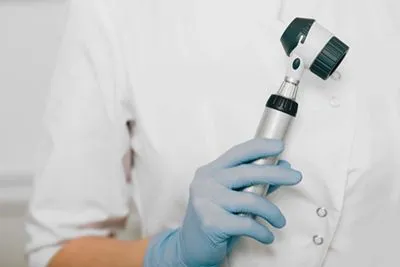
Our doctors/surgeons want to discuss their perspectives on the dermatoscopy procedure with you.
What Is a Dermatoscope?
Medical advancements have developed a hand-held device that enables our doctors to get an extremely close view of extra details otherwise unseen, such as skin moles or melanomas. This hand-held device is pain-free and helps our doctors examine your scalp, hair, and nails for abnormalities and possible skin cancer.
The detail of skin areas uses magnification and light to enable the doctor to see details that are otherwise not visible to the human eye.
What Is the Purpose of a Dermatoscope?
Dermatology & Dermatologic Surgery Group of Northern Virginia, in Vienna VA says this amazingly advanced tool helps to diagnose skin conditions accurately. When our doctors use a dermatoscope to examine skin lesions, their diagnoses are highly accurate. This tool enhances the outer layers of skin for cancerous and noncancerous skin conditions. It brings colors, patterns, and shapes of skin abnormalities into view. Using a dermatoscope with your medical history, age, and family genetics makes a diagnosis highly accurate.
The Difference
This tool magnifies a skin lesion 70 - 100 times higher than the traditional magnification of only ten times. Traditional light sources tend to bounce off dry or oily skin, making it challenging to examine the skin area. The light on a dermatoscope remains on the area the doctor is examining. The dermatocope can take pictures during a skin examination.
The Dermatoscopy Procedure
Using this tool is called a dermatoscopy procedure. It is painless and comfortable. While there are no preop steps, our doctor may perform the following steps.
Gel, alcohol, or water applied to the skin
Activates the light on this tool to look at the area
May gently touch the skin
Provides light and magnification for examination
May take photos of the area
After a Dermatoscopy
Our doctor may follow these steps.
May remove the lesion for biopsy
May not remove the lesion and monitor for changes
May reexamine after some time
Will discuss with you if your lesion is harmless or if cancer